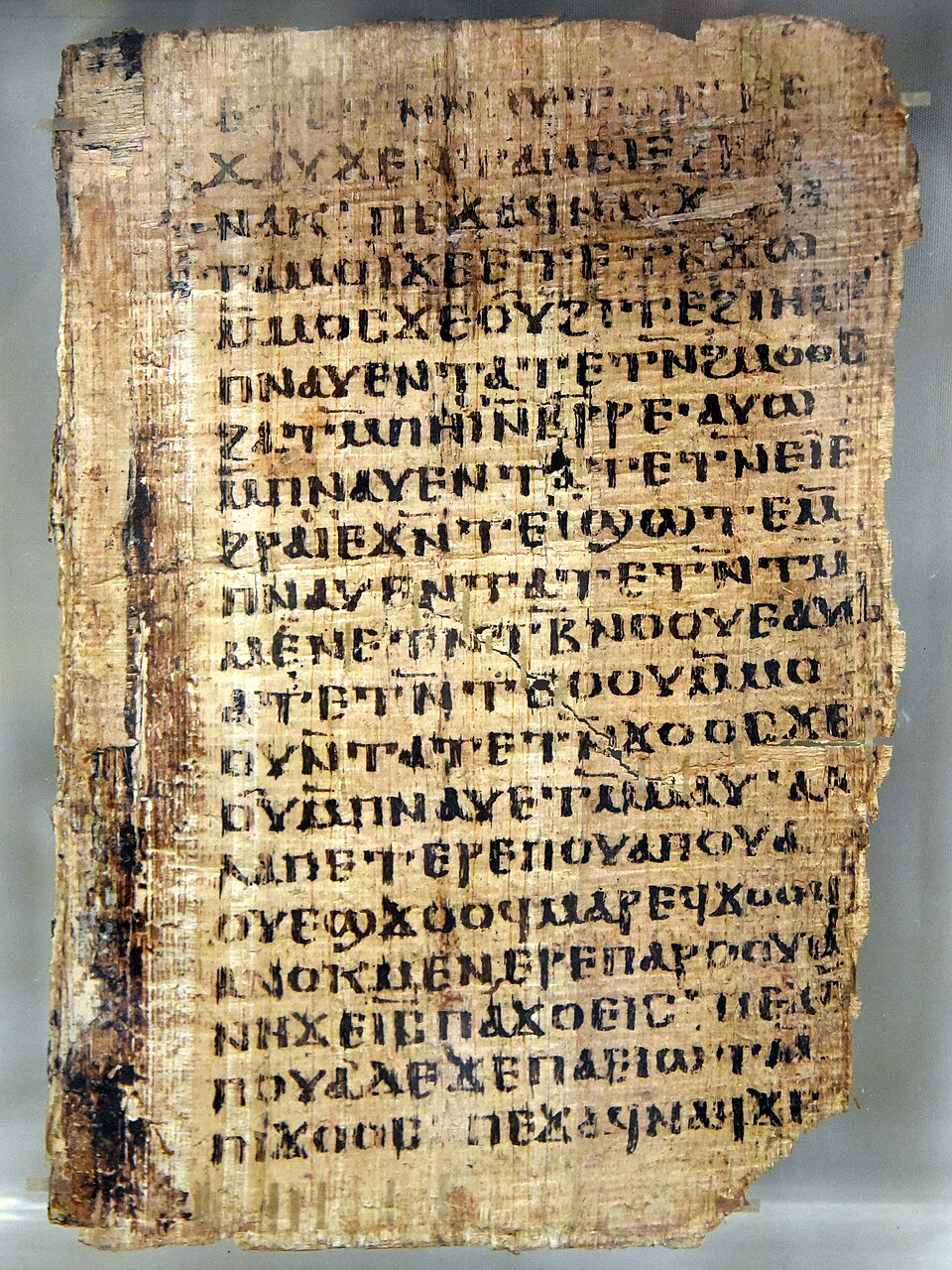
Mesopotamia and Egypt
Sumerian lexical tablets document a learned language transmitted through scribal education after ordinary spoken use waned; Akkadian glosses and later versions show active interpretation. Egyptian provides a different sequence: forms of Egyptian continued through changes of script, and Coptic survived as a liturgical language after its vernacular use ended. Both cases have written survival, but only the Egyptian sequence also illustrates why replacing a script name with a language name creates a false discontinuity.
For each case, avoid one universal “decline” story. DCCLT’s corpus is heavily shaped by school and scholarly genres. Coptic evidence is shaped by manuscript and church preservation. These are strengths for studying institutions and weaknesses for measuring ordinary speech. Compare what the archives allow, not merely which has the later surviving text.
Europe and East Asia
Latin’s continuation into Romance speech while formal Latin remained a learned medium differs again from Sumerian’s case. The Oxford medieval Latin project explicitly describes both regional spoken development and continued written use. In East Asia, literary Chinese and vernacular writing could coexist within a single work; Vietnamese speech existed alongside Chinese official and scholarly writing and a Vietnamese chữ Nôm literary tradition. These cases show that an archive’s prestigious language need not be the sole spoken language of its readers.
Do not equate these settings by labels alone. “Classical,” “learned,” “official” and “vernacular” are descriptions of use in a particular institution and period. The linguistic distance between varieties, their genealogical relation, and the extent of schooling differ. A useful comparison asks one narrow question, such as whether written prestige outlasted native acquisition, and then identifies the different evidence in each case.
The Andes as a modern comparison
UNESCO’s Quechua educator describes Spanish schooling, Indigenous identity and a later campaign for bilingual education. UNESCO’s Kallawaya account describes specialized intergenerational knowledge and a daily social role for Quechua. These are modern cases with speaker perspectives unavailable for most ancient settings. They help formulate questions about domain, transmission and agency, while showing exactly what cannot be retrojected into an undocumented ancient household.
Practice: choose two cases from different regions. Write a one-page comparison with headings for spoken transmission, written domain, institutions, script and evidence limits. Each factual claim should point to the cited institutional source. If the sources are silent about one field, leave it open rather than inventing a symmetry.
Modern-language examples on this page clarify a linguistic pattern. They do not establish unattested sounds or forms for an ancient language. Follow the cited sources below and keep editorial readings separate from the surviving trace.