Three timelines
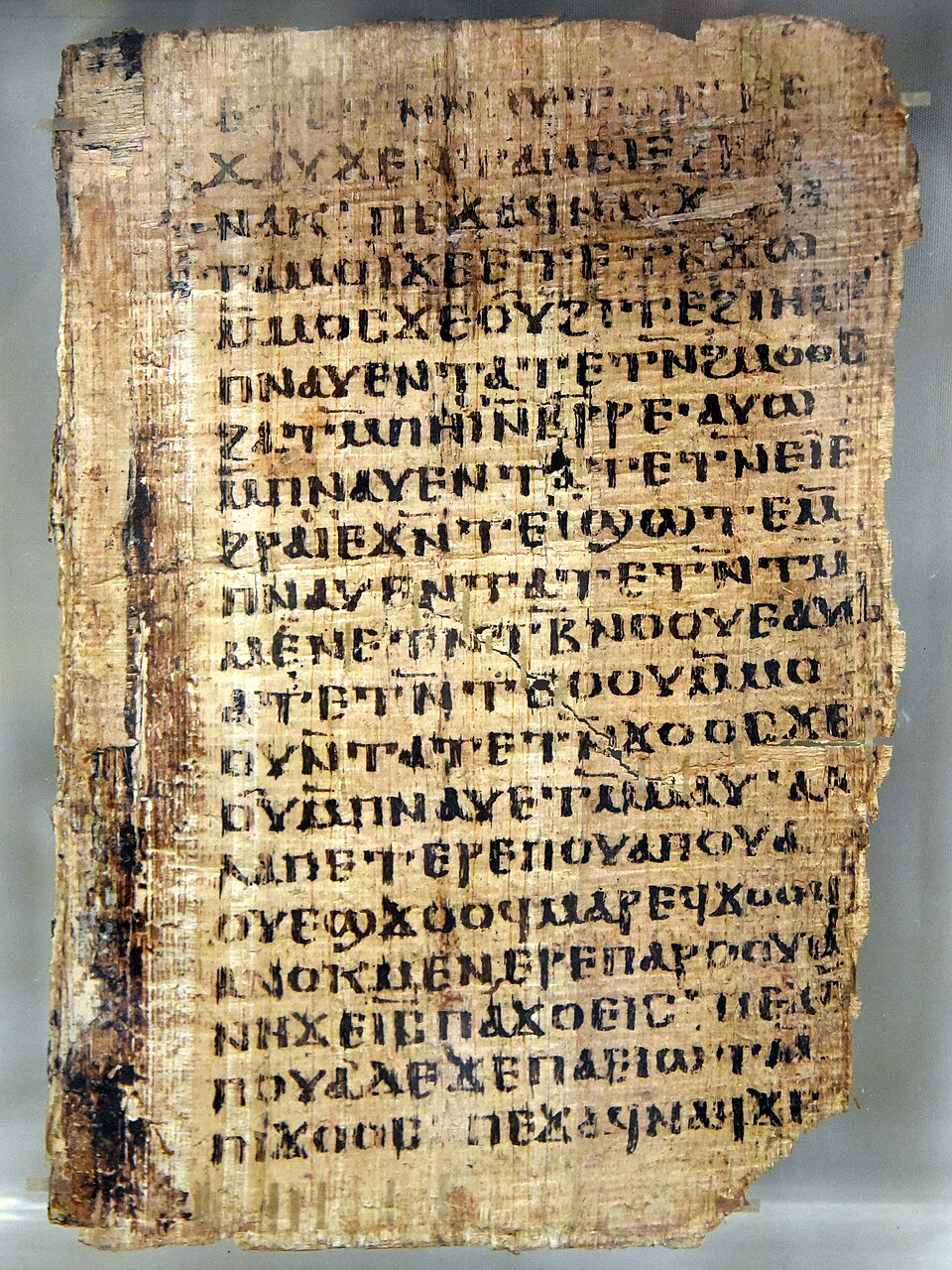
For any historical community, draw at least three timelines: spoken forms, languages selected for writing, and scripts used to write them. They do not have to turn at the same date. Egyptian was written in hieroglyphic, hieratic, Demotic and later Coptic traditions. The Unicode Standard notes that Demotic and Coptic replaced earlier forms for much practical writing while hieroglyphic and hieratic continued in use. A script can decline without the underlying language ending at that moment.
Coptic records a later stage of Egyptian with a script based mainly on Greek letters and supplemented for Egyptian sounds. Unicode documents earlier experiments with Greek-script Egyptian and the later Coptic tradition. The visual resemblance to Greek letters therefore does not make Coptic a stage of Greek. A learner should identify the language of a text independently from the origin of its graphic signs.
One script, several languages
DCCLT describes cuneiform’s use for Sumerian and Akkadian. The same sign inventory could serve different sound systems and reading conventions. Borrowing writing technology can spread rapidly through trained institutions, whereas spoken-language replacement or change follows different social pathways. A newly adopted script might increase the written visibility of a long-spoken language rather than announce its birth.
Vietnamese written with chữ Nôm and classical Chinese writing in Vietnam illustrate a further distinction: the local speech tradition was present while literate domains used different written resources. A script history tells us how a text could be encoded and taught. It cannot by itself answer what language a farmer, merchant or poet used in conversation.
Spellings as indirect evidence
A spelling alternation can reveal pronunciation change, dialect or a scribe’s training. A stable traditional spelling can conceal change for centuries. Before interpreting a spelling as a spoken innovation, compare multiple dated objects, identify the scribal norm, and ask whether the unusual form occurs in the same phonological environment elsewhere. The Dictionary of Medieval Latin notes how medieval spellings may reflect pronunciation while classical spellings often persisted; either pattern needs contextual analysis.
Practice: place an early Egyptian hieroglyphic inscription, a Demotic document and a Coptic manuscript on separate rows. For each record language stage, script, object date and likely social domain. Write one defensible conclusion about continuity and one question these three objects cannot answer.
Modern-language examples on this page clarify a linguistic pattern. They do not establish unattested sounds or forms for an ancient language. Follow the cited sources below and keep editorial readings separate from the surviving trace.