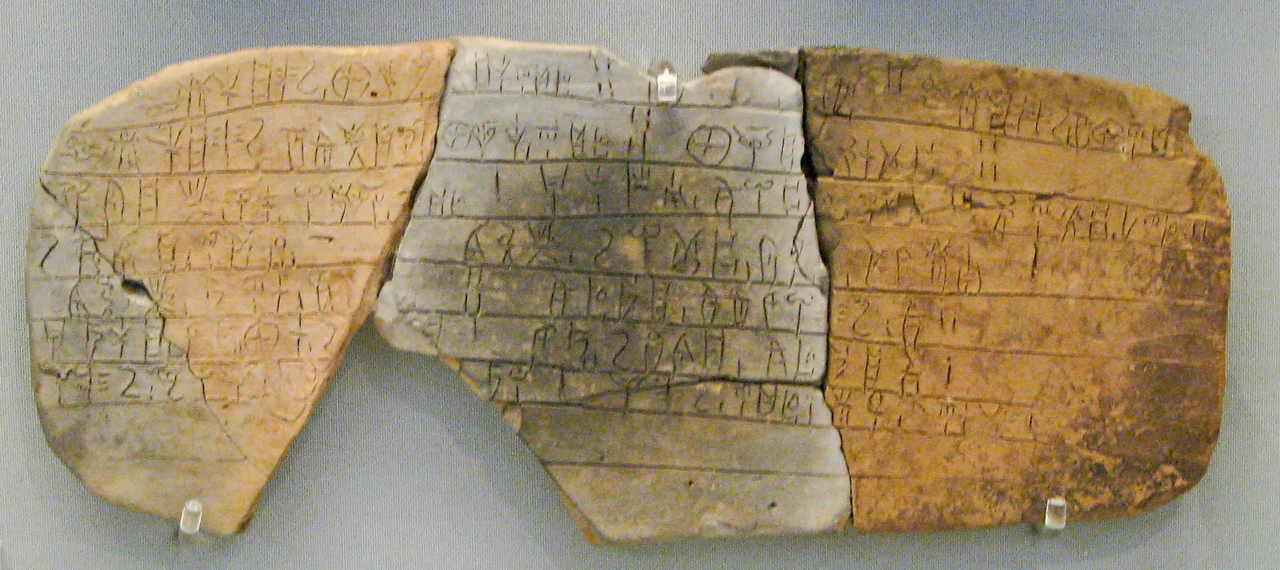
The decree and its limits
The Rosetta Stone preserves a decree of 196 BCE in hieroglyphic, demotic and Greek writing. Greek was readable to nineteenth-century scholars, providing the subject matter and royal names. The three versions are not three alphabets of the same sentence. The Egyptian scripts encode Egyptian, while the Greek version is a translation; damage also removes parts of the text. A name alignment is therefore a foothold, not a complete key.
The monument’s modern discovery and European study are part of the history of decipherment, not the origin of Egyptian knowledge. Egyptian writing had been used for millennia, and Coptic preserved a later form of the language. When teaching the nineteenth-century breakthrough, distinguish ancient Egyptian scribal practice from the later European reconstruction of its rules.
Phonetic and semantic signs
Young recognized some phonetic signs in a royal name. Champollion extended phonetic readings to Egyptian names and words and recognized that the script also used signs with non-phonetic functions. The British Museum describes his analysis of a demotic spelling of Alexandria with a final classifier for a place name. A sign that classifies a word does not have to be read as another syllable in that word.
The decisive advance was explanatory range. The same proposed principles could read material outside one cartouche and connect written forms with Egyptian language evidence. The attractive but false idea that each hieroglyph simply pictures the idea it means would fail on names and grammatical forms.
Practice
Use the British Museum’s illustrated Ptolemy and Cleopatra cartouches. Make a three-column note for each candidate sign: observed shape and position, proposed sound or function, and independent occurrence. Find one sign the source treats as a classifier. Explain why its position supports a different role from the phonetic signs.
Modern-language examples on this page clarify a linguistic pattern. They do not establish unattested sounds or forms for an ancient language. Follow the cited sources below and keep editorial readings separate from the surviving trace.