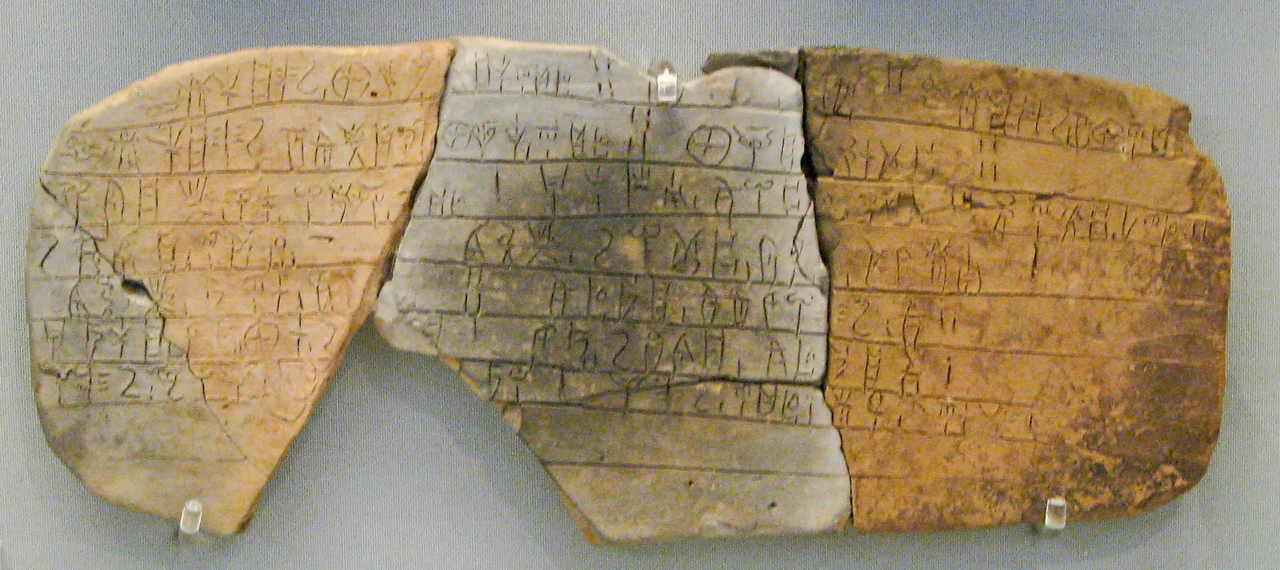
Inventory
A sign inventory groups occurrences judged to perform the same writing function. Rotation, handwriting, damage and material can change a sign’s appearance; two similar shapes can also be different signs. Begin with provisional identifiers, not assigned sounds. For each proposed merger or split, compare positions and neighboring signs. If two forms alternate in the same formula without changing its context, they may be graphic variants; if they contrast in otherwise parallel sequences, the difference may matter.
Counts depend on classification. A list of all drawn shapes may overcount variants; an inventory that merges every similar shape may hide contrasts. Neither a large nor a small count alone proves that a system is alphabetic, syllabic or logographic. A single system may combine sign functions, as Maya writing does.
Direction and grouping
Establish reading direction from repeated layouts, signs that face a consistent way, overlap or spacing. The Smithsonian explains that Maya glyph blocks are commonly read in paired columns, left to right and top to bottom. That is a rule for the cited Maya context, not for every inscription worldwide. On a seal, the carved face and the impression reverse one another; record which is being transcribed. A line break may reflect space on an object rather than a sentence boundary.
Before searching for words, mark repeated sequences and their positions: opening formula, ending, label beside a figure, or group next to a numeral. Treat segmentation as a hypothesis. A recurring final sign may be a grammatical ending, a title, a commodity marker, or simply a fixed part of a name.
Practice
Make two transcriptions of a short photographed inscription: one diplomatic line preserving visible order and damage, and one line of provisional sign IDs. On a second object, locate an exact repeat and a near repeat. Explain which difference could be a variant and what further occurrence would test that choice.
Modern-language examples on this page clarify a linguistic pattern. They do not establish unattested sounds or forms for an ancient language. Follow the cited sources below and keep editorial readings separate from the surviving trace.