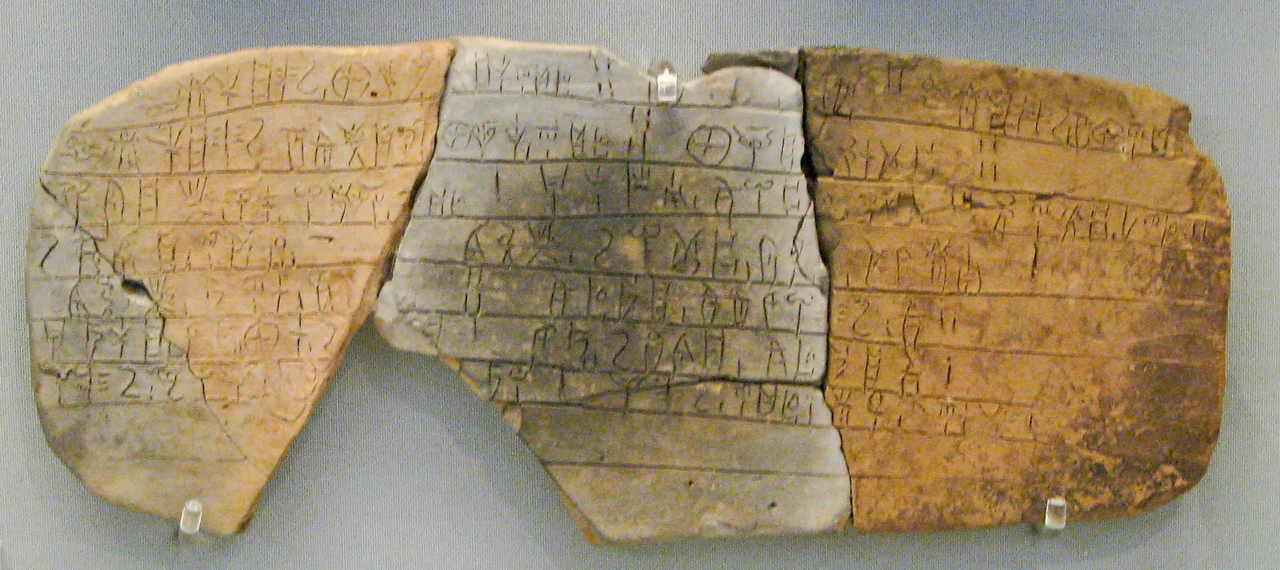
Distribution before meaning
Repeated sign groups can reveal structure even when no word has a known sound. Compare sequences that differ only at the end and occur in related contexts. They may be inflected forms of one word, but they may also be distinct names or a fixed formula. A grammatical proposal needs several sets with the same pattern, not a single convenient pair. Context such as a quantity, commodity drawing or position beside a person can narrow the possibilities without translating the signs.
Alice Kober grouped Linear B forms into recurring alternations and arranged signs in a grid of likely consonant and vowel relations. Her grid captured structural relationships before its cells had secure sound values. The Cambridge excerpt shows that this work enabled later testing. It also notes that some of Ventris’s initial sign values were wrong while many structural relations were right: a good pattern is evidence, but it does not automatically deliver the correct language.
A worked alternation
Chadwick reports the sequence ti-ri-po-de beside ti-ri-po in the Linear B debate. A Greek hypothesis relates these to “tripods” and “tripod”; that reading gains force if the sign values work elsewhere and the tablet’s commodity context fits. The shared ti-ri-po alone does not prove the meaning. To evaluate the hypothesis, hold the sign values fixed and ask whether the extra -de fits the proposed number contrast and whether other recorded forms behave compatibly.
This exercise is a retrospective check using published readings, not an invitation to discover Linear B from two strings. It models how a proposed reading must account for form, context and independent texts at once.
Practice
Copy the two published Linear B transcriptions into a two-row comparison. Underline the shared sequence and circle the extra sign. Write two hypotheses: one grammatical, one treating the strings as unrelated names. Identify one additional tablet context that would discriminate between them.
| Form | Visible comparison | Interpretive test |
|---|---|---|
| ti-ri-po | Shared ti-ri-po | Proposed singular “tripod” |
| ti-ri-po-de | Shared ti-ri-po + de | Proposed plural “tripods” |
Modern-language examples on this page clarify a linguistic pattern. They do not establish unattested sounds or forms for an ancient language. Follow the cited sources below and keep editorial readings separate from the surviving trace.