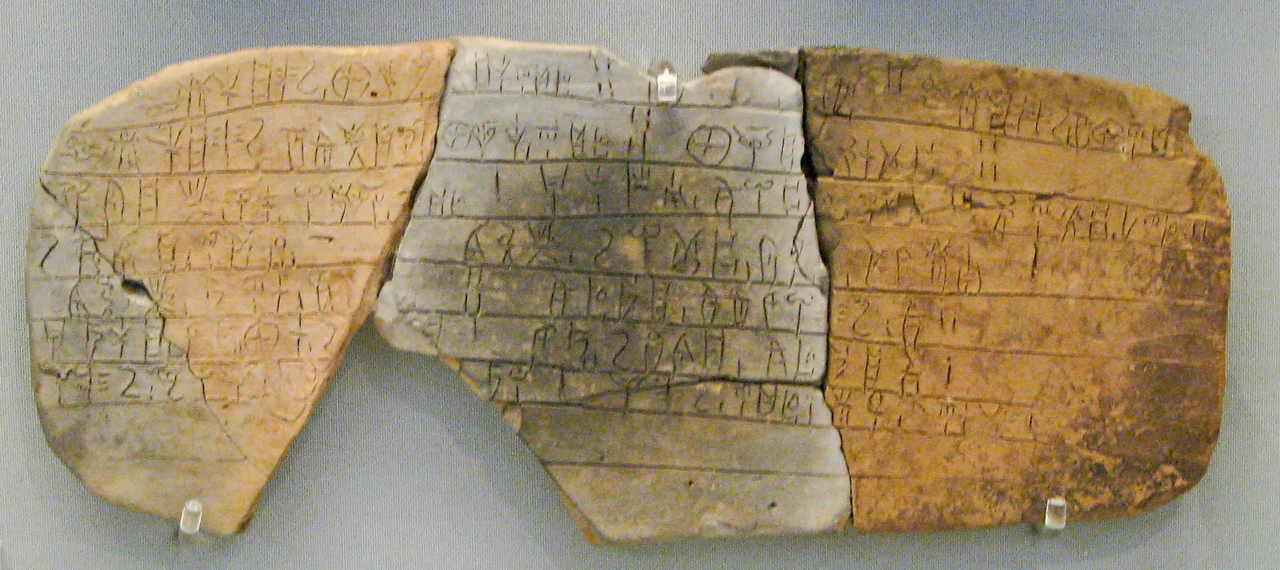
A grid before Greek
Alice Kober compared recurring Linear B sequences and inflection-like alternations. By arranging signs in a grid, she found relationships consistent with a syllabic system before assigning many sounds. This is a model of disciplined analysis when the language is unknown. Ventris expanded such work with a larger published corpus, proposed sign values and in 1952 identified the tablets’ language as Greek. Chadwick helped test and explain the Greek analysis.
The modern scholarly story includes cataloguing and publishing tablets, not only a dramatic announcement. Ventris and Chadwick’s 1953 paper set out evidence for Greek in the Mycenaean archives. The British School at Athens notes that Linear A and Cretan Hieroglyphic remain undeciphered; the success for Linear B does not transfer wholesale to its neighbors.
A substantive reading
The ti-ri-po / ti-ri-po-de comparison is persuasive within a wider set of tablet readings and administrative contexts. Linear B’s syllabic spelling conventions do not write Greek exactly as an alphabet would. The Greek interpretation must account for recurrent forms, numbers, commodities and place names across texts. Chadwick’s account points to successful readings of new material as a crucial check.
A confirmed core reading can coexist with uncertain individual signs, local names and damaged passages. Distinguish “Linear B records Mycenaean Greek” from “every surviving Linear B word has an agreed meaning.” Both the original tablet and the editor’s transliteration remain necessary evidence.
Practice
From the Cambridge excerpt on Kober’s grid, write what a shared row and a shared column predict about two signs before giving either a sound. Then use one published Linear B form to test the Greek hypothesis. List which part of the result depends on the sign grid, which on Greek comparison, and which on tablet context.
Modern-language examples on this page clarify a linguistic pattern. They do not establish unattested sounds or forms for an ancient language. Follow the cited sources below and keep editorial readings separate from the surviving trace.