Distinct questions
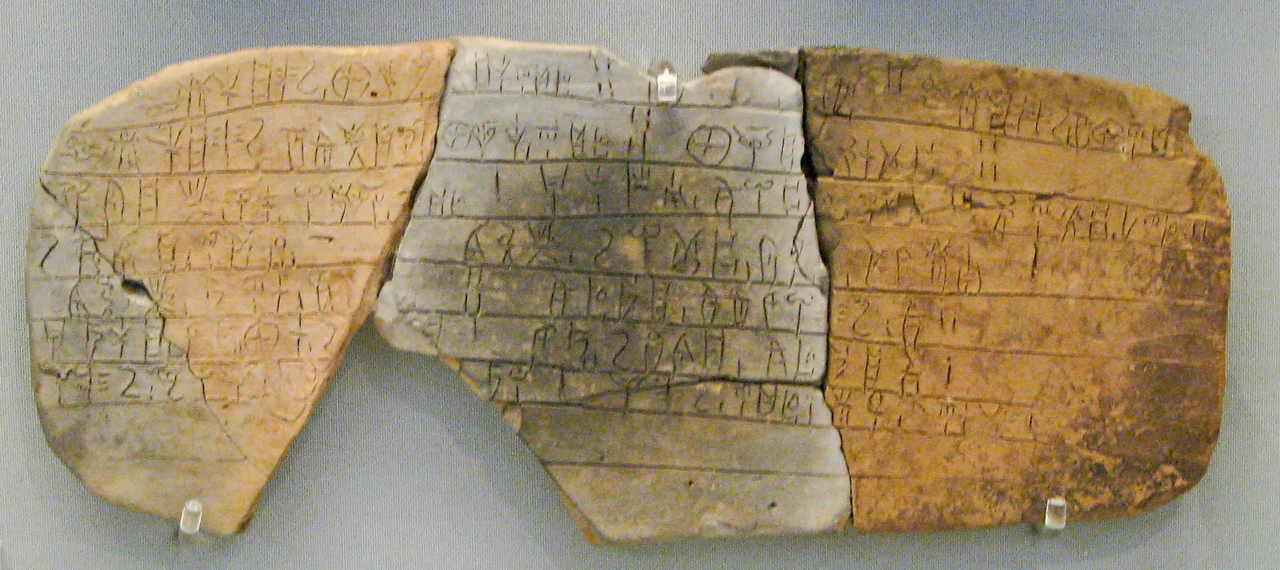
A script is a system of written signs; a language is a system of speech and grammar. One script can be adapted to several languages, and one language can be written in several scripts. Cuneiform was used for Old Persian and for Babylonian, among other languages, but these forms of cuneiform cannot be treated as a single set of sign values. Shared shapes between Linear A and Linear B do not establish that they encoded the same language.
The British Museum’s Meroitic stela shows a useful middle state. Many sound equivalents of Meroitic signs are known, so sequences can be read aloud in a conventional way, while much of the language remains poorly understood. Calling the script “deciphered” without specifying this limit would conceal the central problem.
Functions of signs
A logogram can represent a word or morpheme; a phonogram represents sound material; a determinative classifies a word without normally contributing a spoken syllable. These are functions in an analysis, not visual types. A picture of an animal need not mean “animal,” and a simple wedge need not represent a single consonant. Maya writing combines whole-word signs and syllabic signs, as the Smithsonian describes. Egyptian also mixes phonetic and non-phonetic elements.
Use transliteration to represent signs according to an editorial convention, transcription for a proposed linguistic form, and translation for interpreted meaning. Keep all three labeled. A known sign value is not proof that a neighboring unknown sign shares it, and a plausible translation is not a substitute for a reading.
Practice
Write four separate claims about the Meroitic stela: a visible sign sequence, a conventional sign reading, a proposed language analysis, and an English meaning. Use “unknown” where the source does not supply the next step. Explain why a correct reading of signs can coexist with an uncertain translation.
Modern-language examples on this page clarify a linguistic pattern. They do not establish unattested sounds or forms for an ancient language. Follow the cited sources below and keep editorial readings separate from the surviving trace.