Stroke sequence
Ductus describes how a sign is executed: the number and likely order of strokes, their direction, joins, lifting of the pen or brush, and rhythm. A static image rarely proves every movement. A crossing can sometimes reveal which stroke was laid down later; a broad or thin edge can suggest tool angle; repeated forms show habits. Record these as observations and inferences separately. Do not infer a scribe’s hand from the shape of one isolated letter.
The baseline, x-height or body height, ascenders, descenders, slant, spacing and recurring entry and exit strokes provide a more useful profile than a single decorative flourish. A hurried writer may alter a form within one document. Copy a few repetitions in sequence before deciding whether a difference marks another hand or merely local variation.
Support and implement
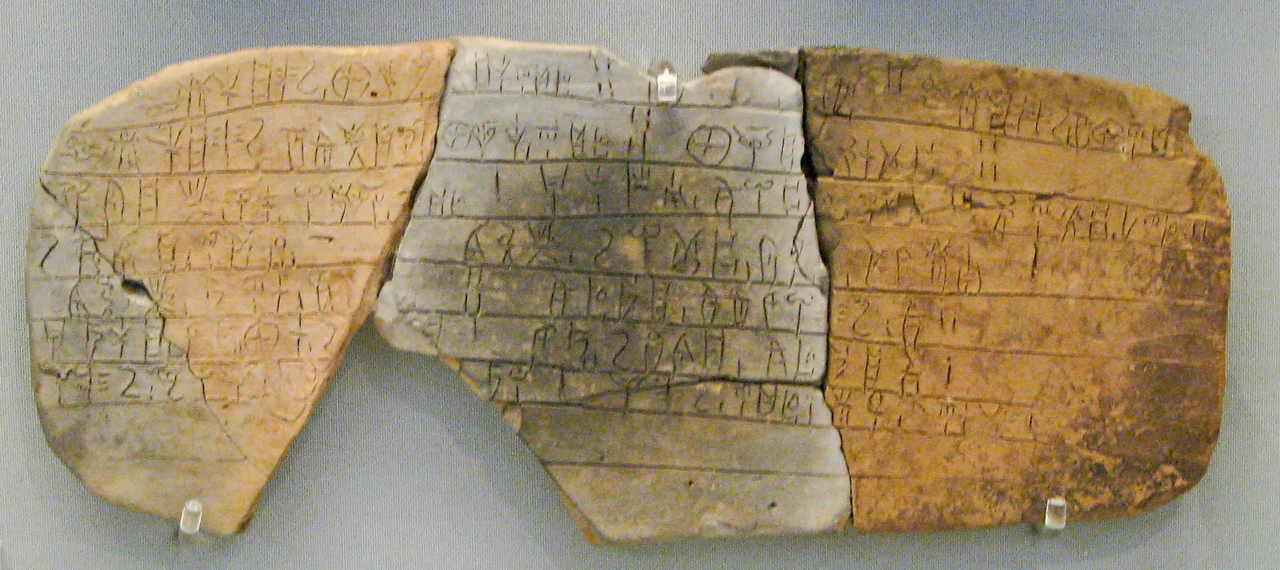
A reed pen on papyrus, quill on parchment, brush on paper and stylus in clay leave unlike traces. The Met’s proto-cuneiform object describes early drawn marks and later wedge impressions; those differences are partly technical, not simply changes in artistic taste. The British Library describes a knife used to sharpen quills, scrape errors and hold parchment. Dunhuang evidence connects brush type and paper supply with manuscript production. A copied chart that suppresses surface texture cannot show all these causes.
Distinguish a mark made during writing from one produced by damage, conservation or imaging. Papyrus fibres can align with a stroke; parchment can show scraping; clay can crack through a wedge. Rotate light or use alternate images when the repository provides them, but keep the unprocessed image beside any enhanced view.
Practice
Compare a repeated sign on the Met’s proto-cuneiform tablet with a repeated letter on Michigan’s P46 alphabet page. For each, describe the trace, tool action and uncertainty about stroke order. Draw one candidate stroke path and mark its inferred segments. Explain why the two objects cannot be dated or identified by applying one shared rule about “neatness.”
Modern-language examples on this page clarify a linguistic pattern. They do not establish unattested sounds or forms for an ancient language. Follow the cited sources below and keep editorial readings separate from the surviving trace.