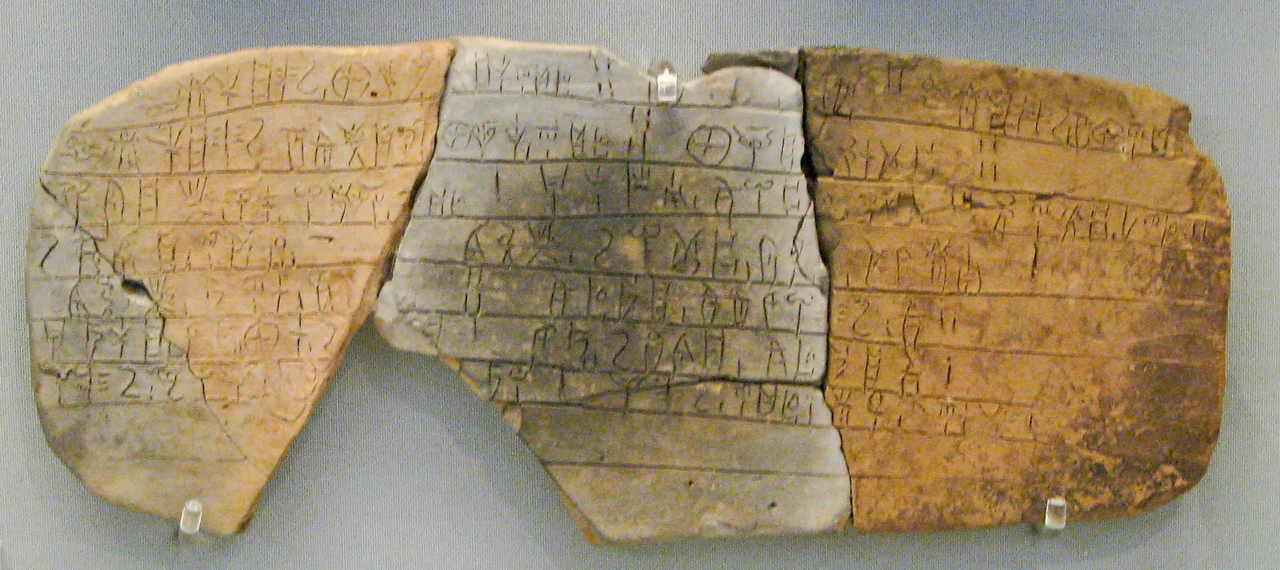
Hand, script and writer
A script is a set of historically shared conventions; a hand is a recognizable performance of them in a witness. “Same hand” is an attribution to one writer, not just a claim that two pages use the same script. Compare a bundle of recurring forms, proportions, spacing, pen angle, abbreviations and corrections. A change in ink or layout may signal a different session or task, but by itself it does not prove a different writer. Conversely, one scribe can use a formal book hand in a heading and a faster style in a note.
The British Library’s Harley MS 2830 record distinguishes a Caroline minuscule main text and a later interlinear copy in a protogothic hand at folio 94r. That is a documented layered page, useful for asking how placement, script and textual function support a distinction. The catalogue’s dating is editorial evidence, not a date written across every stroke.
A comparison matrix
For a suspected hand boundary, select forms present on both sides: at least three letters or signs, plus spacing and abbreviation habits. Compare like with like—main text with main text, not a tiny marginal note with a display title. Write down features that agree as carefully as those that differ. If the surviving samples are too short, the appropriate result is “undetermined.” Names supplied by a colophon, a later owner, or a modern catalogue belong in separate fields.
Digital clustering can help locate candidates but inherits its training labels and image conditions. The International Dunhuang Programme documents how irregular layout, corrections and missing lines complicate automated segmentation and recognition. A proposed hand split still needs inspection of the object and its production context.
Practice
Read the Harley MS 2830 record and inspect the cited folio if an image is available. List three observations you would need to test the catalogue’s distinction between main text and interlinear addition. Class each as graphic, positional, material or textual. State which conclusions remain dependent on the catalogue when the image cannot be consulted.
Modern-language examples on this page clarify a linguistic pattern. They do not establish unattested sounds or forms for an ancient language. Follow the cited sources below and keep editorial readings separate from the surviving trace.