Sign function in a real inscription
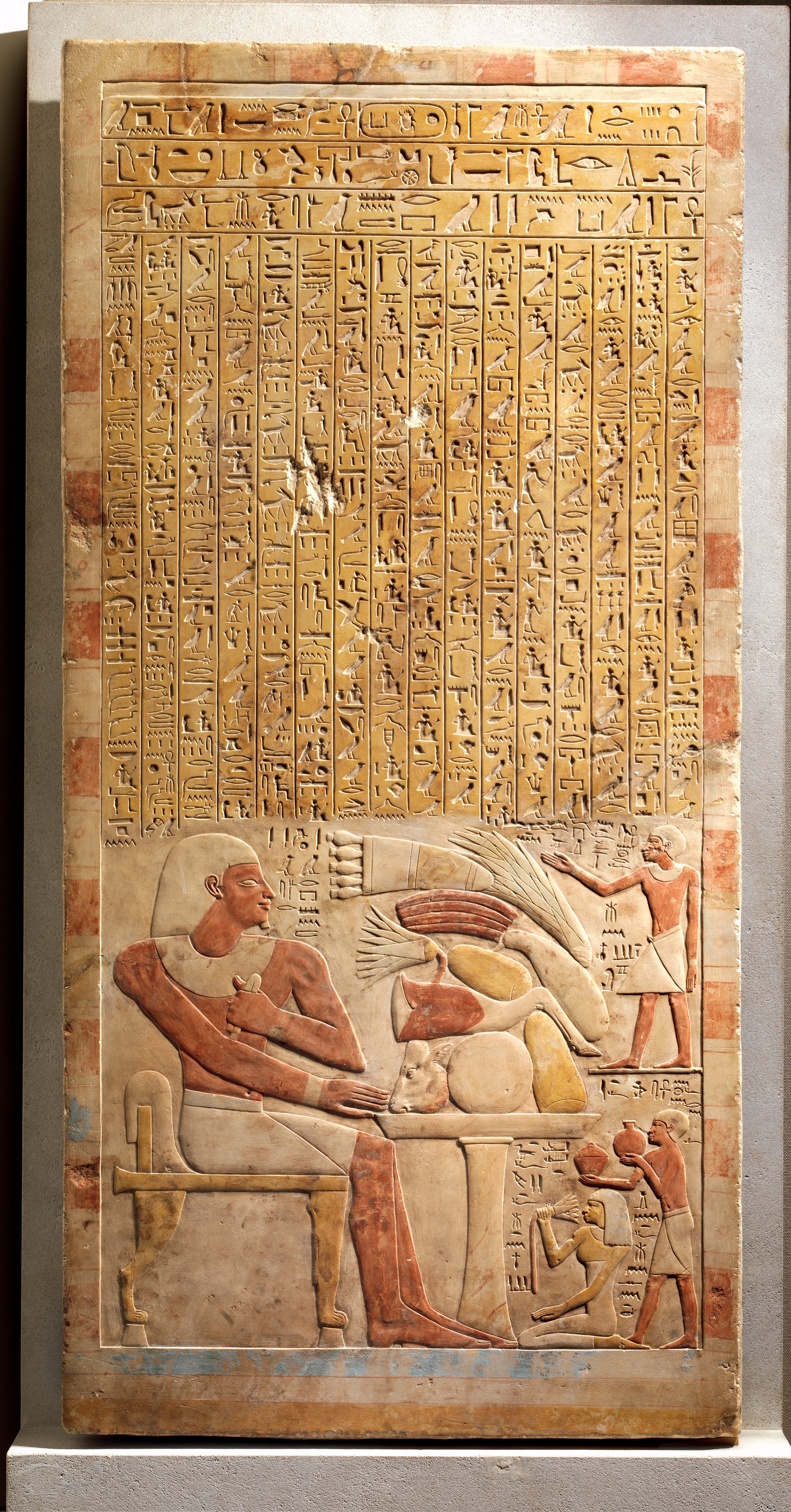
UCL Digital Egypt’s reading of a coffin inscription from Sedment ↗ gives the divine name conventionally transcribed inp (“Anubis”) as three single-consonant signs followed by a jackal-on-shrine sign. A phonogram contributes sound value; a uniliteral phonogram contributes one consonant. The reed leaf M17 is i, water ripple N35 is n, and stool Q3 is p. The last sign, the jackal on a shrine E16 ↗, identifies the god but is not a fourth sounded consonant in this analysis. Such a non-sounded sign at the end of a written word is traditionally called a determinative; “classifier” stresses that it places the written word in a semantic class. This is an analysis of the cited inscription, not a rule that E16 always has the same function in every context.
The sign sequence in editorial reading order is 𓇋 𓈖 𓊪 𓃣 (M17–N35–Q3–E16). Unicode glyphs identify sign types but do not reproduce the original grouping, scale, direction or stroke form. The English name “Anubis” is a conventional Greek-derived name, not a recoverable ancient pronunciation from these consonants alone. In the next phrase UCL identifies tp, a two-consonant sign associated with “head,” used here for “on”; the mountain sign writes ḏw (the source's Dw) pictorially; f marks “his.” Thus one short inscription already shows phonetic, pictorial and semantic uses rather than a one-sign/one-word alphabet. UCL’s sign-function guide ↗ distinguishes phonograms, determinatives and ideograms.
Four signs, three consonants
Sedment coffin, short Anubis inscription, UCL Digital Egypt sign-by-sign reading · UCL Digital Egypt, the system of hieroglyphic writing: Sedment coffin sign-by-sign reading ↗
Evidence
- Text or forms
- 𓇋 𓈖 𓊪 𓃣
- Transliteration
- inp + Anubis classifier
- Translation
- Anubis
Reading the evidence
- Identify
- M17 reed leaf, N35 water ripple and Q3 stool each contribute one consonant: i + n + p.
- Classify
- E16 depicts a jackal on a shrine. UCL treats it here as the nonsounded determinative identifying the deity.
- Do not infer
- Neither the modern Unicode font nor the consonant string records the ancient vowels, brush strokes or spatial arrangement.
The signs are displayed in analytical order, not as an image or diplomatic copy of the coffin.
One sign, several roles
A biliteral phonogram contributes two consonants and a triliteral three; a phonetic complement is an additional sound sign that repeats part of a neighbouring multi-consonant sign to guide reading, rather than adding a new phoneme to the word. In the Sedment example ↗ UCL points out a reed-leaf i beside an im sign: the i helps specify the adjacent sign and is not read as an extra syllable. “Transliteration” records an editor's consonantal analysis in Latin-letter notation; it is not a photograph of the inscription.
A logogram (often called an ideogram in older introductions) can write an entire word; UCL lists the house sign 𓉐, O1, with pr “house” ↗ as an example. The same pictorial sign may function as a word sign in one spelling and as a classifier of a semantic domain in another. Its outline alone does not determine its function. A sign list classifies shapes; a reading of a particular inscription classifies each occurrence by its position and neighbouring signs.
Hieratic is a script, not a different language
UCL’s illustrated hieratic survey ↗ identifies Petrie Museum UC 32245 as a mid-Eighteenth-Dynasty ostracon letter from the scribe Baki to the scribe Meh. An ostracon is a sherd or stone flake used as a writing surface; on this one a reed brush formed cursive ink signs. The cited page provides a photograph and an English summary, not a sign-by-sign diplomatic transcription. It would be false to draw an assumed hieratic spelling of “Baki” or “bird” from that summary. Compare the photograph with a scholarly facsimile or edition when one is available; mark image, sign identification, transliteration and translation as four separate layers.
“Hieratic” is the conventional modern name for a range of cursive Egyptian writing, not a single unchanging font. UCL distinguishes Old, Middle, Eighteenth-Dynasty and Ramesside hands and shows that the more cursive Demotic later developed alongside continued hieratic use. The shared underlying Egyptian writing system allows an editor to transcribe a hieratic sign as a hieroglyphic sign identity, but the displayed hieroglyph is an editorial normalization, not the ink shape on the ostracon. Unicode explicitly notes ↗ that hieratic is usually rendered by the corresponding hieroglyphic characters for legibility.
Palaeographic concordance
A Gardiner number classifies a sign identity by subject group; it is not a date, a word meaning or the number of strokes. “M” groups plants, “N” sky/earth/water, “Q” furniture and “E” mammals. The St Andrews concordance ↗ relates Möller’s hieratic palaeography entries 282, 331, 388 and 130 to hieroglyphic M17, N35, Q3 and E16. Those are sign-type correspondences across reference works; they do not assert that all four signs occur in UC 32245. Its editors warn that some Möller-to-hieroglyph identifications are uncertain and must be checked against facsimiles in context. A ligature is a joined cursive writing of two or more signs; it can make a hieratic word harder to segment by eye. The Hieratische Paläographie Database ↗ offers image-region curation and concordance data under CC BY 4.0, so a learner can compare dated handwritten forms rather than inventing a generic hieratic glyph.
| Printed sign | Gardiner | Function in UCL’s coffin example | Möller concordance |
|---|---|---|---|
| 𓇋 reed leaf | M17 | One-consonant phonogram i | 282 |
| 𓈖 water ripple | N35 | One-consonant phonogram n | 331 |
| 𓊪 stool | Q3 | One-consonant phonogram p | 388 |
| 𓃣 jackal on shrine | E16 | Divine classifier after inp; not an extra sounded consonant here | 130 |